Ginger and Ken drive to Alaska from Texas, through Wichita, Madison, Chicago, Corpus....

We decided to make a lifestyle change and move. Following are tales of our trips, packing mishaps, beautiful drives, visitations and more! This is Texas2Alaska2 because it is my second time to make the drive.
Showing posts with label mineral spring. Show all posts

Sunday, November 7, 2010

Old Faithful Boardwalk Part II "Micro" Education

The new visitor center at Old Faithful is clean, large, and professional. there is a huge theater set up with interpretive displays galore. There is information on the mechanics of the geysers, paleontology, flora and fauna. You can find information on the ecology of the hot springs. Yes, there are plants and critters that live in and around the water. You can also learn about scientific research in the area. Information is not just for adults, a children’s exhibit is on display as well.  There is a fabulous virtual center here http://mms.nps.gov/yell/ofvec/index2.htm 
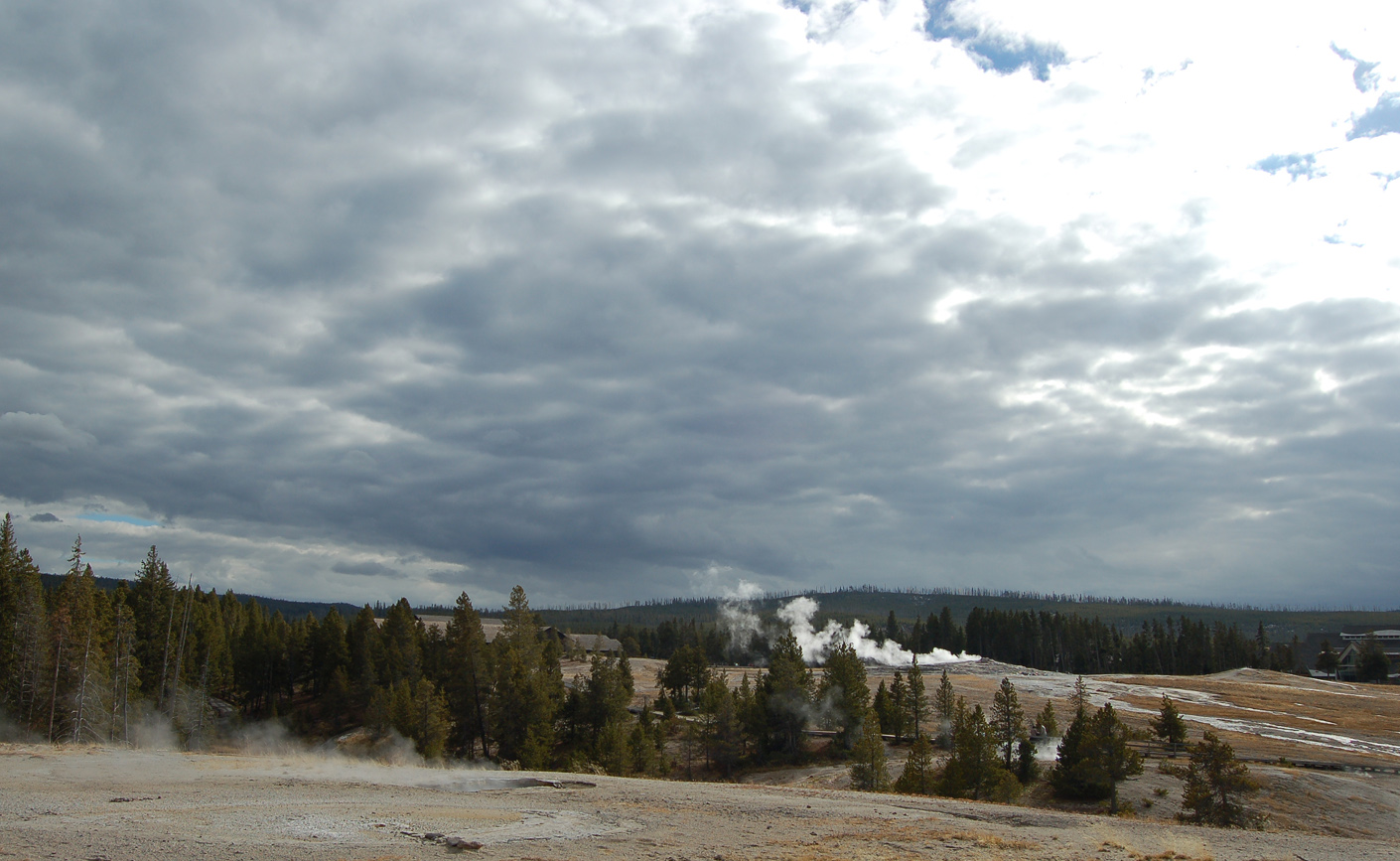

Over-mineralization from the geysers has caused these dead pine trees to look white. Most of the pine that thrive around the thermal areas are lodge pole.


In my previous post I thought ‘what about those early visitors who may have drunk the water-what happened to them?’ Here is why we know not to drink it directly now, it is full of bicarbonates (not so bad), chloride-mmmm, arsenate- beware!, sulfuric acid, and sodium. Most of these minerals end up as deposits along flows that create what I call hard ‘bubbles’ and white cascades. The most dramatic are from the carbonate springs.


Some of the microbes that live in the water give the hot pots their bright colors. (The same was true of the water flow at Thermopolis). Guess what these bacteria, algae, and  protozoa are called? Extremophiles! As the display says “what else could live in water filled with baking soda or acidic enough to burn holes in clothing?”


While these intense levels of minerals and strange micro-organisms may not be good for us to ingest, they are good for the greater macro-environment. The substances flowing out of the thermals supply rivers and habitats downstream with nutrients for plant growth and food for larger insects and fish. 
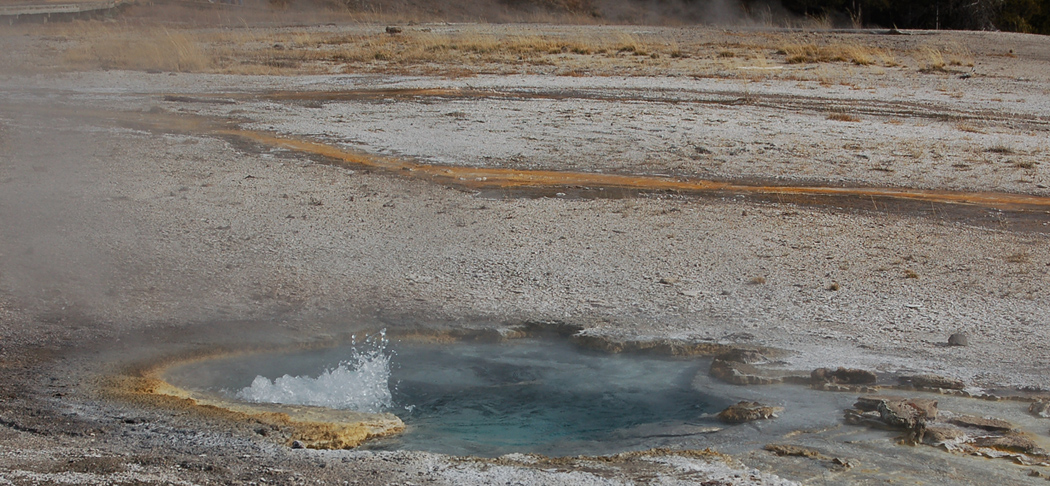


OK, that was everyone’s basic education on how our environments are intertwined! 
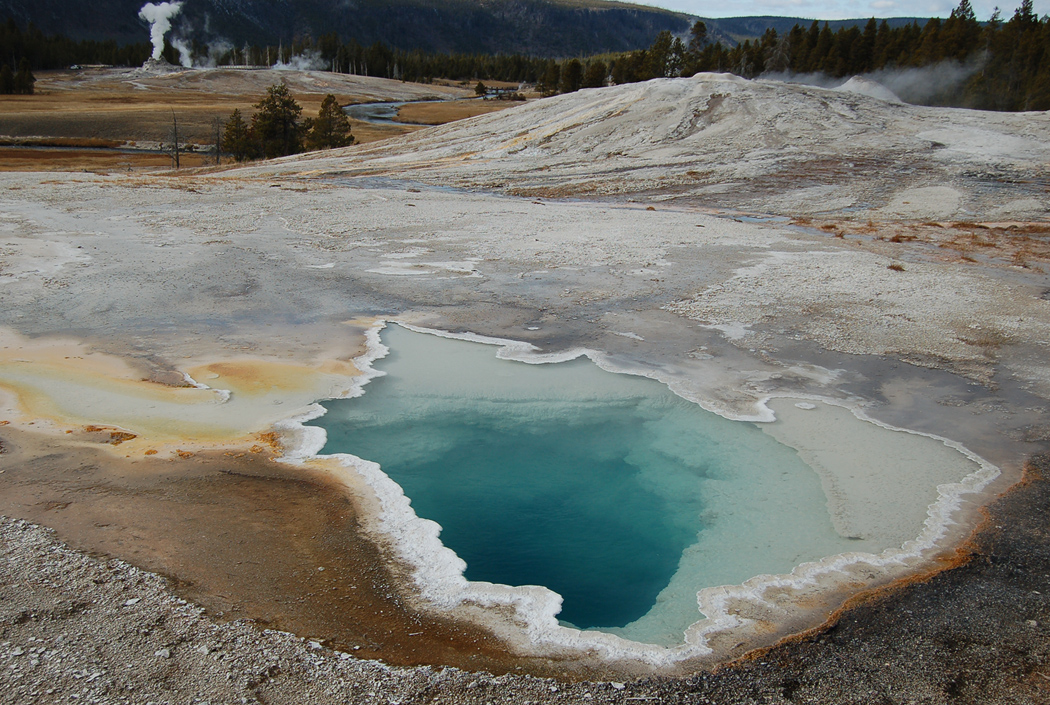


Kind of gives you an idea of how agates are formed.


Yellowstone-Its more than just one Geyser!


The scenery on the boardwalk at the Old Faithful visitor center was just as beautiful and inspiring as the main attraction itself. The trail goes past Castle Geyser, Beehive Geyser, Daisy Geyser, Grand Geyser, among others that erupt just as impressively as the big one although at many different intervals. 


Remember our stop just yesterday at Thermopolis? (really, a couple of posts ago) Does any of this hot pot, natural spring landscape look familiar? Similar underground activity at work here. 


There is a long boardwalk over delicate natural features.  Some of the surfaces cannot support the weight of people. Some are gooey, some are deep holes!

Imagine this: my great Uncle Andy worked here around the time of the depression at what he called a “dude ranch.” He and my grandfather and the whole family grew up in the west (Montana, Wyoming, Utah, Idaho, Arizona). They were very much cowboys. One summer Andy, who at the time was probably late teen or early twenty-something, got the job of bear wrangler. Back then everyone around, including the park service, would feed the bears in order to bring them in close for the ‘dudes’ and tourists. Can you imagine that being done now?


At that same time, early in the history of Yellowstone, visitors walked all over the hot spring and geyser areas. How many people burned themselves? Or drowned? Or how many uneducated ‘dudes’ drank the sulfur strong water? Can you imagine walking on these features today? Not really, although somewhere else on the earth someone probably has a feature like this on their property that they and the animals traverse without a second thought. I personally don’t think that would cause any damage on a private scale. However, reserving the broad landscape here considering the throngs that visit during the summer does make sense. 


Sadly, we did not go to Mammoth on this trip. Just leaves a reason to stop in again on our way back to Kansas to retrieve more of our belongings. 


Look closely at the main stream on this geyser, you can see the water swirl as it is ejected!


Saturday, November 6, 2010

Thermopolis, World’s Largest Mineral Hot Springs, a Great Rest Stop on the Road


The scenic byway of the Wind River continues a little past Thermopolis, however, I was determined to stop for a soak in the mineral springs. There are three bath house opportunities for soaking, two are mini-theme parks garishly colored and filled with cooky rides and slides, the third middle house is the state park http://wyoparks.state.wy.us/Site/SiteInfo.asp?siteID=9 . I like to say its the one instance where the U.S. government kept its agreement with the Native Americans. The agreement with the Eastern Shoshone and Northern Arapaho Indian tribes when the U.S. absconded with their land, was that the hot springs remain free to the people in perpetuity. And today it is. 
In a theme that has been and will be with us throughout this trip, we got there in the nick of time. The free park closed at 5:30 and we arrived at 4:30. There is a limit on soak time of 15 minutes and we were stymied by the outdoor pool being closed for cleaning but had the backup opportunity for the indoor pool. With such beautiful weather out, it would have been nice to soak it all up outside. Regardless, the healthful benefits of a mineral soak were not to be missed. 


The bath spring water is maintained at 104 degrees Fahrenheit. Minerals found in the water include sulfur, calcium sulfate, magnesium, sodium, hydrogen carbonate, and many more. Very considerate of nature to put these ingredients all in a blend that is habitable to humans! 
As mentioned, Ken and I arrived in time to relax and enjoy a soak in the bath house. The building has a wonderful picture window view of the nearby mountains seen from the pool. I cannot fault the park service for putting a limit on the spring soak, 15 minutes was just about right. There were a few other folks soaking in the time we were there and everyone was calm and happy! Thank you to the geothermal processes!


After our soak, we took a nice stroll on the boardwalk over the mineral pools to the historic suspension bridge that crosses the Rocky Mountain Big Horn River (the Wind River changes names when leaving the canyon). 


The dissolved and deposited limestone in the form of calcium gives the overflow edge along the river the big cascade effect. Just the right temperature and mineral combination also makes the water home to numerous algae which decorate parts of the surface pools with vibrant colors. For a DOE technical analysis of the geographical formation, see this pdf site http://www.osti.gov/bridge/purl.cover.jsp?purl=/6053845-rsRTid/native/ 

I am not a scientist, but I could not help thinking when looking at old photos, and even my own memory of 10 years ago, that there seemed to be less flow of spring water today than in the past. It could have just been the season, or day, or cycle. I hope these springs continue to flow for generations to enjoy. We did have a pleasant evening.