Ginger and Ken drive to Alaska from Texas, through Wichita, Madison, Chicago, Corpus....

We decided to make a lifestyle change and move. Following are tales of our trips, packing mishaps, beautiful drives, visitations and more! This is Texas2Alaska2 because it is my second time to make the drive.

Sunday, November 7, 2010

Yellowstone in One Day-Not Recommended for the Slow Natured at Heart


How lucky can we humans be in this day and age to have the ability to visit acres and acres of gorgeous scenery in one day! Don’t get me wrong, I am not advocating it, as I would have liked to stay for days in order to fully learn and appreciate the environment. But with our cars and high speed cameras, we are able to sight see a lot in the span of twelve hours! 


At a fork in the visitor central trail system, there is a path through nearby woodlands that leads to a high viewpoint overlooking Old Faithful. This is Geyser Hill where we caught the one more eruption of Old Faithful from a high vantage point.  The new Old Faithful Visitor Center is directly behind the geyser, the lodge is to the right. 


Our visit was timed just about right considering we only had this day. There was a little snow storm coming and as such the Park Service had made the announcement that all roads would be closed as of November 8. This morning had started out stunningly blue, as the day wore on, the clouds closed in and by night fall we knew we had to get out of the park and find a place to hunker down. 


Our drive out the west entrance was just as exciting at the ride in from the east. More mountains, buffalo, and elk, and sumptuous creek beds all made for a nice exit. 


Sadly, we did not go to Mammoth on this trip. Just leaves a reason to stop in again on our way back to Kansas to retrieve more of our belongings. 


With the closing of the park to automobiles, the east and west entrances were ghost towns at this time of year. Amazingly, the entrances are not flanked by huge cities. They are very small communities keeping the park low key. As I mentioned before, some of my relatives spent a lot of time growing up in the western states. They were there from the 1800's through the 1960's. The picture below reminds me of looking at my grandfather's photo albums. His mother had a Kodak Brownie and that got him hooked on photography (and his work at Eastman) and he got me hooked. Grandpa narrated his photo albums to me whenever he had a chance. The photos were aged just so and full of history. When I view my photo in this style, I can imagine Yellowstone the way he would have seen it when he and his mother photographed and painted the west. (only after taking the photo, grandpa would have taken the elk for dinner! A necessity in the early part of the 20th century.)


The relatively low lack of development is a nice observation for an eco-conscience person, however, for a person looking for a place to sleep, its a challenge. Like with eastern Wyoming, even the RV parks are closing up for winter. As such, we kept driving to Idaho Falls. Another family memory is Uncle Andy saying he would have been traveling this area on foot with a bed roll on his back. Then he'd just plop down anywhere he wanted to rest!  We're such poofs!

Old Faithful Boardwalk Part II "Micro" Education

The new visitor center at Old Faithful is clean, large, and professional. there is a huge theater set up with interpretive displays galore. There is information on the mechanics of the geysers, paleontology, flora and fauna. You can find information on the ecology of the hot springs. Yes, there are plants and critters that live in and around the water. You can also learn about scientific research in the area. Information is not just for adults, a children’s exhibit is on display as well.  There is a fabulous virtual center here http://mms.nps.gov/yell/ofvec/index2.htm 


Over-mineralization from the geysers has caused these dead pine trees to look white. Most of the pine that thrive around the thermal areas are lodge pole.


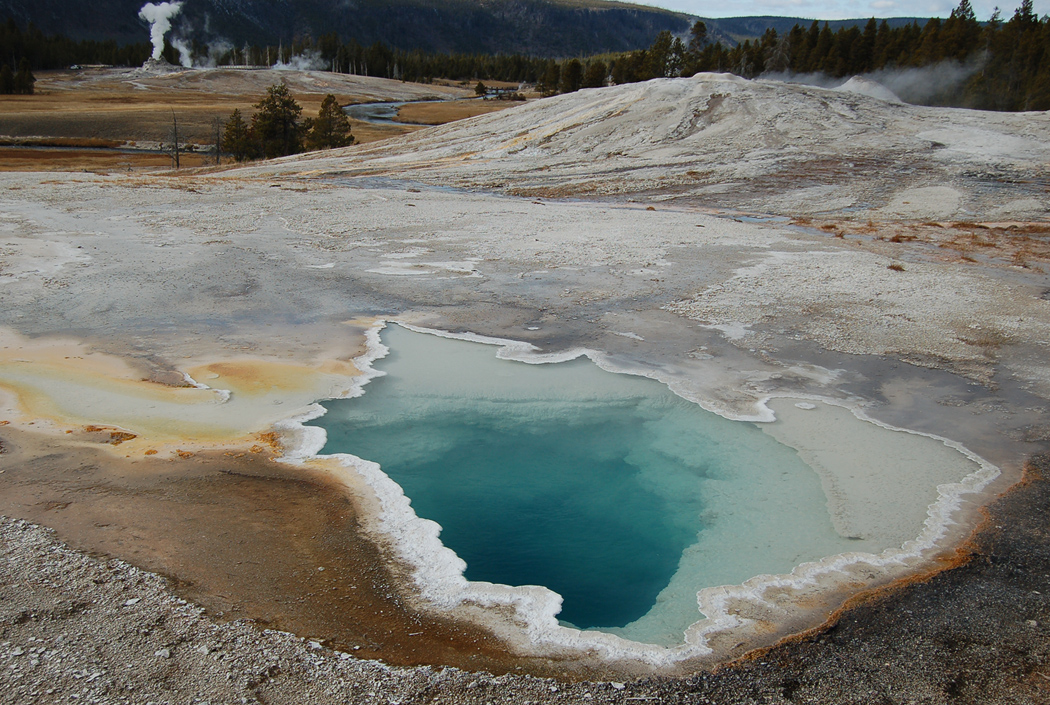
In my previous post I thought ‘what about those early visitors who may have drunk the water-what happened to them?’ Here is why we know not to drink it directly now, it is full of bicarbonates (not so bad), chloride-mmmm, arsenate- beware!, sulfuric acid, and sodium. Most of these minerals end up as deposits along flows that create what I call hard ‘bubbles’ and white cascades. The most dramatic are from the carbonate springs.


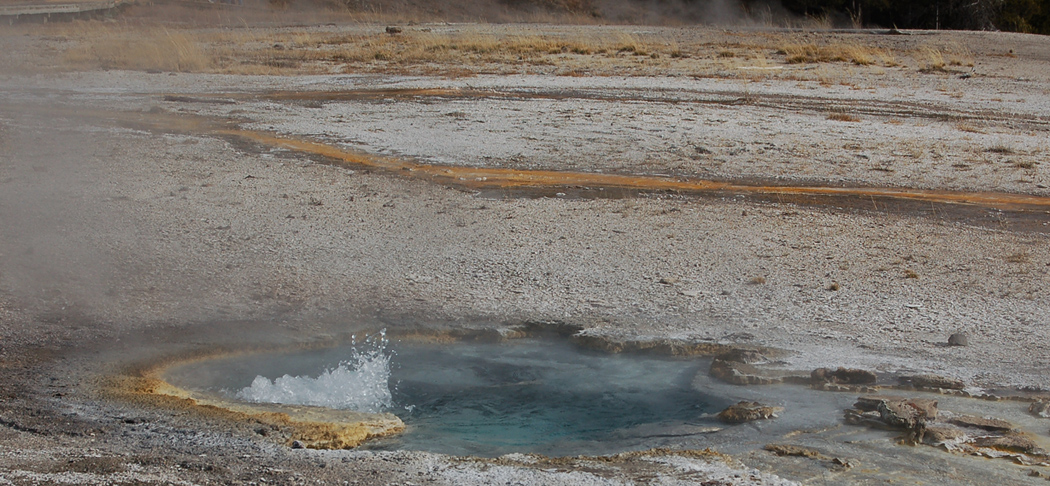
Some of the microbes that live in the water give the hot pots their bright colors. (The same was true of the water flow at Thermopolis). Guess what these bacteria, algae, and  protozoa are called? Extremophiles! As the display says “what else could live in water filled with baking soda or acidic enough to burn holes in clothing?”


While these intense levels of minerals and strange micro-organisms may not be good for us to ingest, they are good for the greater macro-environment. The substances flowing out of the thermals supply rivers and habitats downstream with nutrients for plant growth and food for larger insects and fish. 


OK, that was everyone’s basic education on how our environments are intertwined! 


Kind of gives you an idea of how agates are formed.


Yellowstone-Its more than just one Geyser!


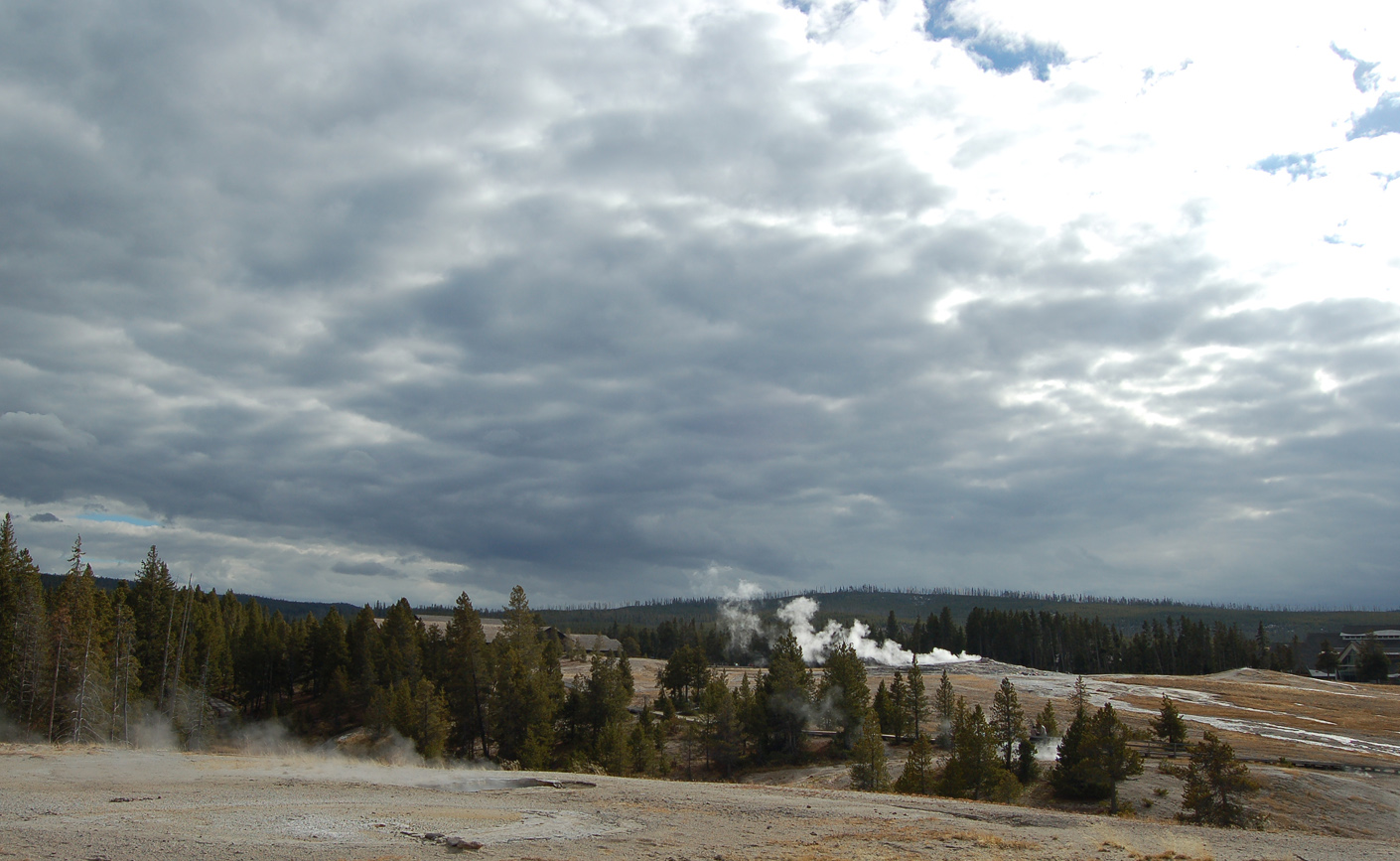
The scenery on the boardwalk at the Old Faithful visitor center was just as beautiful and inspiring as the main attraction itself. The trail goes past Castle Geyser, Beehive Geyser, Daisy Geyser, Grand Geyser, among others that erupt just as impressively as the big one although at many different intervals. 


Remember our stop just yesterday at Thermopolis? (really, a couple of posts ago) Does any of this hot pot, natural spring landscape look familiar? Similar underground activity at work here. 


There is a long boardwalk over delicate natural features.  Some of the surfaces cannot support the weight of people. Some are gooey, some are deep holes!

Imagine this: my great Uncle Andy worked here around the time of the depression at what he called a “dude ranch.” He and my grandfather and the whole family grew up in the west (Montana, Wyoming, Utah, Idaho, Arizona). They were very much cowboys. One summer Andy, who at the time was probably late teen or early twenty-something, got the job of bear wrangler. Back then everyone around, including the park service, would feed the bears in order to bring them in close for the ‘dudes’ and tourists. Can you imagine that being done now?


At that same time, early in the history of Yellowstone, visitors walked all over the hot spring and geyser areas. How many people burned themselves? Or drowned? Or how many uneducated ‘dudes’ drank the sulfur strong water? Can you imagine walking on these features today? Not really, although somewhere else on the earth someone probably has a feature like this on their property that they and the animals traverse without a second thought. I personally don’t think that would cause any damage on a private scale. However, reserving the broad landscape here considering the throngs that visit during the summer does make sense. 


Sadly, we did not go to Mammoth on this trip. Just leaves a reason to stop in again on our way back to Kansas to retrieve more of our belongings. 


Look closely at the main stream on this geyser, you can see the water swirl as it is ejected!